BearWise Press Room
About BearWise
BearWise® is an education and outreach program founded, supported and funded by member state wildlife agencies. Today BearWise is a national program of the Association of Fish and Wildlife Agencies (AFWA).
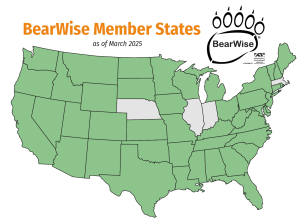
BearWise is managed by a national team of state agency bear biologists and communications professionals from the private sector, working together to ensure that no matter where people live, play or travel, they get the same consistent about living responsibly with bears.
Sound Science, Real World Solutions
The BearWise team works together to ensure that BearWise content, messaging and materials reflect both sound science and the everyday realities of living, working and recreating in bear country.
BearWise® Created by bear biologists. Supported by State Wildlife Agencies. Dedicated to helping people live responsibly with bears.
How to Write, Talk (and Think) BearWise
You have the power to help everyone understand how and why people (often unintentionally) cause most human-bear conflicts. And even more importantly, how living BearWise can prevent them.
Communication Guide Contents:
Let’s Talk Bears – 1
– Consequences of Attracting Bears
– Bears Are Not Furry People
– Don’t Blame the Bear
Responsible Communication – 2
Terms to Avoid, Phrases to Use – 3
BearWise as Your Resource – 4
– How to Use Our Name & Content
– Interviews, Experts, Research
Using BearWise Content
BearWise outreach materials (free downloads in our store) may be reproduced as is and shared, posted, printed.
The BearWise article bank features dozens of articles meant to be shared. Our primary focus is on easy-to-understand, proven ways to prevent conflicts with bears at home and outdoors and help keep people safe and bears wild. Our regular features on bear behavior and biology help people understand what drives bear behavior.
Subscribe to receive BearWise articles and announcements as soon as they are published.
When sharing/reprinting BearWise articles: BearWise content is copyrighted. You may reprint, redistribute or excerpt without changing or altering content in any way. Required credit line: Courtesy of BearWise® | BearWise.org
Please notify us where BearWise content will be used.
To request written permission for any other use, please contact us.
Using BearWise Photos/Videos: Many photographers have granted BearWise the right to use their photos because they support the BearWise mission. For permission to use a BearWise photo, please contact support@BearWise.org.
View Articles by Category
Using the BearWise Name / Logo
The name BearWise® and the BearWise logo are registered trademarks, and must be used in accordance with our guidelines. Download BearWise Name & Logo Usage Guide.
BearWise is one word, with a capital B and W.
The BearWise brand name should not be altered. BearWise is not an organization or group. Misuse makes BearWise seem like just a clever play on words rather than a national program.
-
No quotation marks (“BearWise”)
-
Never in possessive form (BearWise’s)
-
Do not use lowercase (bearwise or Bearwise)
-
Not hyphenated (Bear-Wise)
The registered trademark symbol ® is required with the first or primary use of BearWise in any printed or digital materials or messaging (press releases, newsletters, blogs, etc).
When listing our website, please capitalize the B and W: BearWise.org
Request hi-res logo (provide your name, organization/publication, phone number)
The BearWise® name and logos are registered trademarks of the Association of Fish & Wildlife Agencies and may not be used on educational, promotional or commercial materials or products without prior written approval from BearWise.
BearWise in the News
“Fall means black bear feeding frenzy”
November 16, 2024 | The Plumas Sun
Plumas County / City of Portola, CA
“Bear activity on the rise in Southwest Reno, officials urge residents to be BearWise“
November 13, 2024 | News4
Reno, NV
“Woman Walks Down Stairs and Finds Bear in Her Kitchen in Shocking Clip”
November 6, 2024 | Newsweek
Truckee, CA
“Beware of Bears: Helene caused an increase in interactions with people”
October 4, 2024 | Spectrum News1
Buncombe County, NC
“Breaking News: Black bear sightings are growing in Kansas”
August 3, 2024 | Brady Today
Brady and McCulloch County, KS
BearWise Press Releases & Announcements
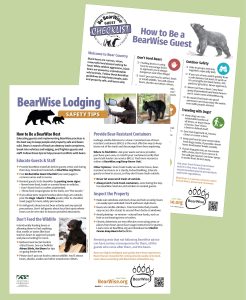 Bears belong in bear country. Bears don’t belong in trash containers, picnic grounds, swimming pools, vehicles, buildings and lodging. Two new fact sheets from BearWise will help lodging providers and their guests keep bears where they belong and out of where they don’t.
The Be BearWise Guest Checklist is organized into seven categories and emphasizes safely stashing the trash, discouraging bear break-ins and why feeding bears is so dangerous. There are tips on cookouts, outdoor safety and what to do if you encounter a bear and important precautions for people traveling with dogs.
The BearWise Lodging Safety Tips Fact Sheet is packed with valuable information on how to be a BearWise host, useful tips for training staff and educating guests from reservation to checkout, how to bear-proof your property (did you know bears can open car doors and French doors?), and links to other useful resources.
Who’s using: Short-term rentals, resorts, camps, clubs, homeowner associations, visitor centers, parks and forests, outdoor educators, libraries, NGOs.
Benefits: Help guests have a safe vacation, go home with happy memories and be inspired to post great reviews. Help staff do a better job of dealing with constant guest turnover and ongoing maintenance. Avoid messy cleanups and prevent expensive property damage. And feel good about helping to keep bears wild.
Cost & Format: Free, print-ready PDF (2 pages)
Where to Find: Download
BearWise®. Created by bear biologists. Supported by State Wildlife Agencies. Dedicated to helping people live responsibly with black bears.
Copyright © 2024 Association of Fish & Wildlife Agencies
BearWise Contacts
National Chairman:
Nate Bowersock, Missouri Department of Conservation
Nathaniel.Bowersock@mdc.mo.gov
Communications and Marketing Director:
Linda Masterson
media@bearwise.org, 970-231-7500
To inquire about ordering outreach materials for a state agency:
support@bearwise.org
State Bear Management Information:
Every state wildlife agency has unique factors that steer state bear management policies and actions. To request information about bears in a specific state or a state-specific issue, incident, situation or action, contact the state wildlife agency directly. BearWise does not comment on these types of state-specific matters.